
“Running 24 hours a day, how much extra will the monthly electricity bill be?” Many bakery owners worry about power consumption after purchasing commercial cake refrigerators. Some call them “power hogs,” while others report “lower electricity use than expected.” Today, we’ll use real-world data and professional analysis to clarify this issue and help you avoid electricity cost traps!
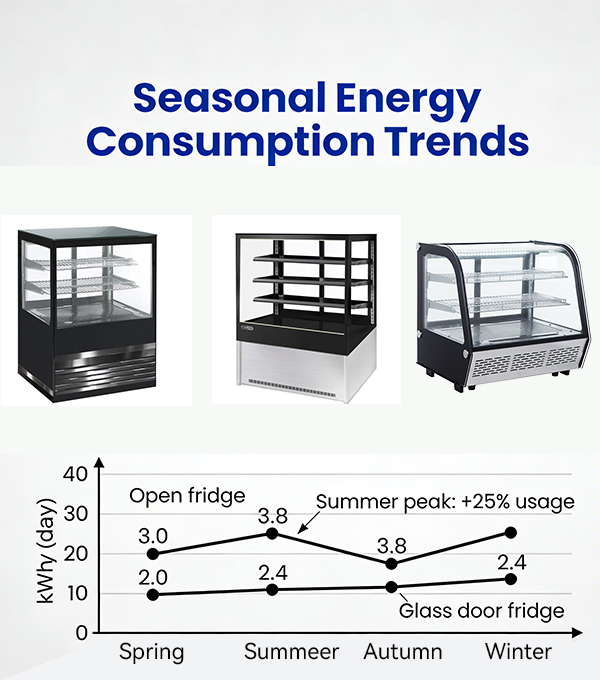
First, the core conclusion: Commercial cake display refrigerators aren’t “power-hungry monsters.” Their average daily electricity consumption typically ranges from 2 to 5 kWh, accounting for 15%-20% of a bakery’s monthly electricity bill. The exact amount depends entirely on these three key factors—especially the last one, which many overlook.
I. Actual Power Consumption by Model: Data Speaks for Itself, No Fluff
Power consumption is directly linked to cabinet size and cooling method. We’ve compiled actual test data for popular 2025 models—see the comparison for clarity:
| Model Type | Common Capacity/Dimensions | Average Daily Power Consumption | Representative Models/User Feedback |
|---|---|---|---|
| Small Single-Door Refrigerator | 100-300L/0.9-1.2m> |
1.5-3 kWh
|
Xingxing LC-1.2YE approx. 2 kWh/day; Taobao user test: “Running 24/7, only about 2 kWh per day” |
|
Medium-sized double-door cabinet
|
300-600L/1.5-2.0m | 2.5-5 kWh/day | Shanghai Jincheng ZWD2E-06 (1.8m) power 0.97kW, average daily consumption approx. 4kWh; Haochuguan 2.0m air curtain cabinet energy-saving model approx. 3.5kWh |
| Large island/multi-door cabinet | 600L+ / 2.0m+ |
5-15 kWh
|
Traditional island cabinets average 8-15 kWh daily; BAVA constant-temperature cabinets reduce consumption to 7.2 kWh/day via honeycomb insulation design |
Key reminder: Air-cooled models consume 10%-20% more power than direct-cooled ones, but eliminate manual defrosting—ideal for busy bakeries. Direct-cooled units save energy, yet frost layers exceeding 5mm increase power consumption by 15%.
II. Why Such a Huge Difference in Power Consumption? 3 Core Variables
Beyond the model itself, daily usage details are the real “hidden killers” of power consumption:
1. Cooling Method: Air-Cooled vs. Direct-Cooled – Choose Right to Save Half
This is the primary factor affecting power consumption. Air-cooled models use fans for refrigerant circulation, ensuring even temperatures and automatic defrosting, but fan operation consumes extra power. Direct-cooling relies on natural convection, eliminating extra energy use but prone to frost buildup—thick frost layers reduce cooling efficiency. Simply put: If budget is tight and you can manually defrost, choose direct cooling. For hassle-free operation, opt for air-cooled models, prioritizing inverter types (20%-30% more energy-efficient than fixed-frequency models).
2. Usage Habits: These Actions Consume the Most Energy
- Door Opening Frequency: Frequent door openings cause significant cold air loss, directly increasing energy consumption by 30%-50%. Consider posting “Open Less, Retrieve Quickly” reminders and encourage staff to retrieve items in batches.
- Temperature Settings: The optimal temperature for cake preservation is 5-8°C. Setting it to 2°C wastes an extra 1-2 kWh/day—completely unnecessary.
- Placement: Positioning near heat sources (ovens, windows) forces the compressor to work harder. Every 1°C increase in ambient temperature boosts power consumption by 5%. Leave at least 10cm of clearance above and on both sides for heat dissipation.
3. Energy Efficiency Rating: Significant Difference Between Grade 1 and Grade 5
Per the 2025 Commercial Refrigeration Appliance Energy Efficiency Standard, cake display cabinets are rated from Grade 1 to Grade 5. Grade 1 models save 1-2 kWh daily compared to Grade 5. For example, the Haier LC-92LH9EY1 (Class 1) consumes only 1.2 kWh daily, while some niche brands’ Class 5 models of similar capacity may exceed 3 kWh daily—resulting in hundreds of dollars in annual electricity savings.
III. 3 Must-Know Baking Energy-Saving Tips: Save Enough for a Mini Fridge in Half a Year
Instead of worrying about power consumption, proactively manage it. These proven techniques work:
- Prioritize Grade 1 energy efficiency + inverter technology: Though initial costs are 5%-10% higher, you recoup the investment within six months through electricity savings. For example, Nenwell’s NW-R series uses Embraco energy-saving compressors, saving 0.8 kWh daily compared to standard models—equivalent to 292 kWh annually.
- Don’t skip regular maintenance: Defrost monthly (when frost layer <5mm) and clean condenser dust to reduce power consumption by 15%. If glass doors fog up, inspect the seal strips—air leaks can increase energy consumption by 20%.
- Leverage “Night Mode”: For small shops closed at night, activate night mode (available on select models) or cover the cabinet with a night curtain to minimize cold air loss, saving 0.5–1 kWh daily.
IV. Controllable Power Consumption: Choosing and Using Correctly is Key
Commercial cake refrigerators’ power consumption is entirely controllable: Small shops using a 1.2-meter Class 1 energy-efficient air-cooled cabinet incur about 36 yuan monthly (0.6 yuan/kWh); Medium shops using two double-door cabinets incur about 300 yuan monthly; Large chain stores can also keep per-store refrigeration costs under 1000 yuan by using energy-efficient models and adhering to standard operating procedures. Rather than fixating on “power consumption levels,” prioritize purchasing Grade 1 energy-efficient units with inverter compressors and maintaining them properly during use. After all, compared to these electricity costs, losses from improper cake preservation represent a far greater expense.
Post time: Dec-16-2025 Views: