
“Boss, this 300W cooling capacity model will be plenty for you!” “Go with the 500W one—it cools faster in summer!” When buying beverage display cabinets, do you always get confused by sellers’ “technical jargon”? Choose too small, and drinks won’t chill properly in summer, driving away customers. Choose too big, and your electricity bill skyrockets—pure waste of money.
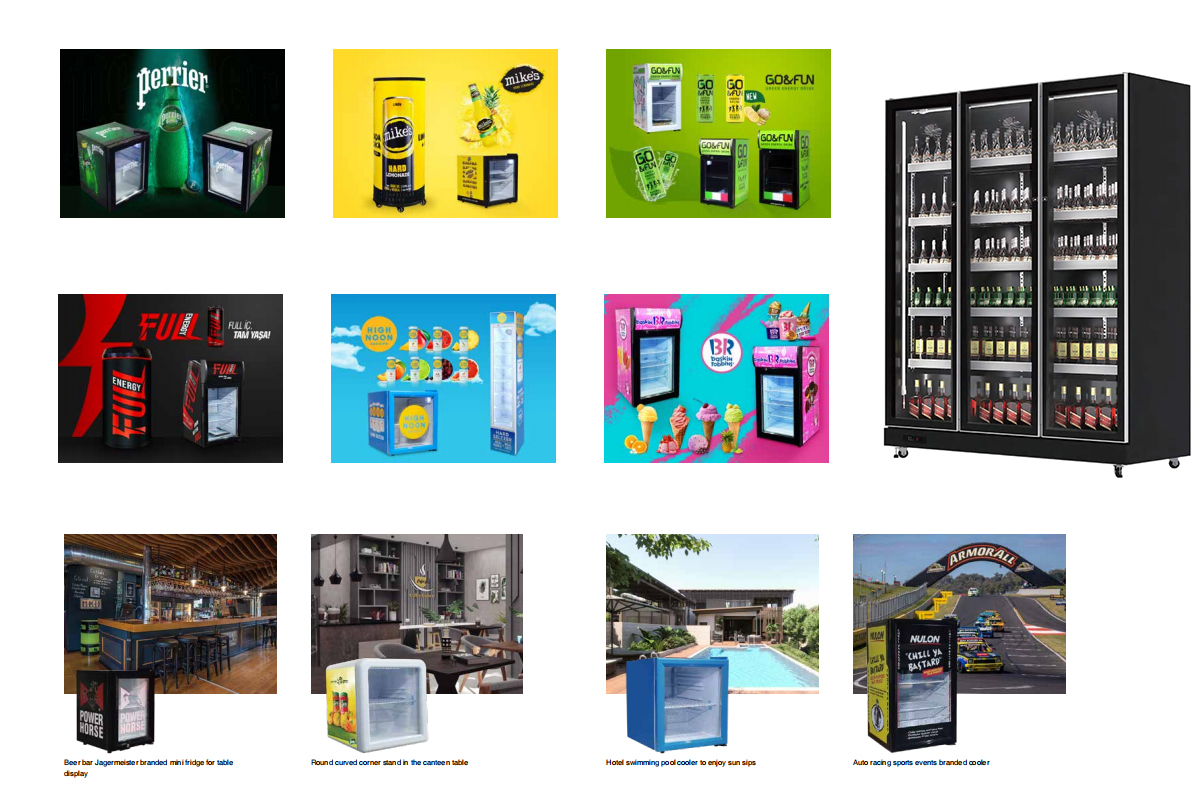
Today we’ll break down the formula for calculating beverage display cabinet cooling capacity. No need to grasp complex principles—just follow the formula and examples step by step. Even beginners can precisely match their needs.
I. First Understand: Why Must You Calculate Cooling Capacity Accurately?
Cooling capacity represents a display cabinet’s “cooling power,” typically measured in watts (W) or kilocalories per hour (kcal/h), where 1 kcal/h ≈ 1.163 W. Accurate calculation serves two core purposes:
- Avoid “overkill”: For instance, in summer when convenience store doors open frequently, insufficient cooling capacity prevents the cabinet from reaching the optimal 3-8°C (the ideal temperature for preserving beverages). Carbonated drinks lose their fizz, juices spoil easily, and you end up losing money.
- Prevent “overkill”: A 20㎡ store unnecessarily purchasing a 500W high-capacity display cabinet wastes 2-3 extra kWh daily, adding hundreds to annual electricity costs—purely unnecessary.
Key takeaway: Higher cooling capacity isn’t always better—it’s about “matching demand.” Focus on three core variables: display cabinet volume, operating environment, and door opening frequency.
II. Core Formula: 3 Steps to Calculate Precise Cooling Capacity (Even Beginners Can Master)
No need to memorize complex thermodynamics principles—just remember this practical formula: Cooling Capacity (W) = Display Cabinet Volume (L) × Beverage Density (kg/L) × Specific Heat Capacity (kJ/kg·℃) × Temperature Difference (℃) ÷ Cooling Time (h) ÷ 1000 × Correction Factor
Let’s break down each parameter step by step, using a “1000L convenience store display cabinet” as an example:
1. Fixed Parameters (Apply directly, no changes needed)
|
Parameter Name |
Value Range |
Description (Layman’s Terms) |
|---|---|---|
|
Beverage Density (kg/L) |
0.9–1.0 |
Bottled beverages (cola, mineral water) generally fall within this range; use the midpoint value of 0.95 |
|
Specific Heat Capacity (kJ/kg·℃) |
3.8-4.2 |
Simply put, this represents “the heat required to raise/lower the temperature of a beverage.” For bottled drinks, 4.0 is the most accurate value. |
|
Cooling time (h) |
2-4 |
Time to cool from room temperature to 3-8°C: 2h for convenience stores (frequent door openings require rapid cooling), 3-4h for supermarkets |
2. Variable Parameters (Fill in based on your actual situation)
- Display Cabinet Volume (L): This is the ‘capacity’ labeled by the manufacturer, e.g., 1000L, 600L. Simply copy the stated value.
- Temperature Difference (°C): Ambient Temperature – Target Temperature. Assume summer room temperature is 35°C (most extreme case), target temperature is 5°C (optimal beverage taste), thus temperature difference = 35 – 5 = 30°C.
3. Substitute into formula for calculation (using 1000L convenience store display cabinet as example)
Refrigeration capacity (W) = 1000L × 0.95kg/L × 4.0kJ/kg·℃ × 30℃ ÷ 2h ÷ 1000 × 1.2 (correction factor) Step-by-step calculation: ① 1000 × 0.95 = 950kg (Total beverage weight inside cabinet) ② 950 × 4.0 × 30 = 114,000 kJ (Total heat required to cool all beverages) ③ 114,000 ÷ 2 = 57,000 kJ/h (Refrigeration capacity required per hour) ④ 57,000 ÷ 1000 = 570 W (Base cooling capacity) ⑤ 570 × 1.2 = 684W (Final cooling capacity; correction factor explained later)
Conclusion: For this 1000L convenience store display cabinet, summer requires approximately 700W cooling capacity. 600W is slightly insufficient, while 800W is marginally excessive but more reliable.
III. Key Supplement: How to Determine the Correction Factor?
The “1.2” above isn’t arbitrarily added; it’s adjusted based on actual usage scenarios. Different situations correspond to different coefficients. Select directly based on the following:
- Correction factor 1.0-1.1: Supermarket display cabinets (low door opening frequency ≤20 times daily), air-conditioned indoor environments (ambient temperature ≤28°C), direct-cooling models (good insulation).
- Correction factor 1.2–1.3: Convenience stores/small shops (frequent door openings ≥50 times daily), non-air-conditioned environments (ambient temperature ≥32°C), air-cooled models (prone to cold air loss).
- Correction factor 1.4–1.5: High-temperature regions (summer ambient temperature ≥38°C), open-air stalls (direct sunlight), display cabinets near heat sources (e.g., adjacent to ovens or heaters).
IV. Model Selection Comparison Table for Different Scenarios
|
Usage Scenario |
Display Cabinet Volume (L) |
Recommended Cooling Capacity (W) |
Notes |
|---|---|---|---|
|
Neighborhood convenience store (no air conditioning) |
300-500 |
300-450 |
Moderate opening frequency; air-cooled models offer greater peace of mind |
|
Convenience stores (high foot traffic) |
600-1000 |
600-750 |
Prioritize models with energy-saving mode to reduce electricity costs |
|
Supermarket beverage section (air-conditioned) |
1000-2000 |
700-1200 |
Multi-door models allow zone-specific temperature control for greater energy efficiency |
|
Outdoor Stalls (High-Temperature Areas) |
200-400 |
350-500 |
Choose models with sunshades to reduce direct sunlight exposure |
V. Pitfall Alerts: 2 Common Tricks Used by Vendors
- Listing only “Input Power” without “Cooling Capacity”: Input power indicates the display cabinet’s electricity consumption, not its cooling output! For example, with the same 500W input power, a quality brand may achieve 450W cooling capacity, while a subpar brand might only reach 350W. Always request the seller to provide a “Cooling Capacity Test Report.”
- Inflating cooling capacity figures: For instance, a unit with actual 600W cooling capacity might be labeled as having “peak cooling capacity of 800W.” Peak values represent instantaneous readings under extreme conditions and are unattainable during normal operation. When selecting, focus solely on the “rated cooling capacity.”
Remember 3 Core Principles
1. Larger capacity means higher cooling capacity: Each 100L increase in capacity adds approximately 50-80W of cooling power. 2. Hotter environments and frequent door openings require extra capacity: Add at least 10% buffer to the calculated result. 3. Prioritize Grade 1 energy efficiency: For the same cooling capacity, Grade 1 efficiency saves 1-2 kWh daily compared to Grade 5, recouping the purchase price difference within six months.
Post time: Dec-16-2025 Views: