
Countertop pastry display cabinets are mainly used for fresh-keeping at ambient temperature and low-temperature display of various cakes, breads, desserts and other pastries. They slow down food deterioration through a constant low-temperature environment. In daily store operations, frequent malfunctions include the cabinet failing to cool, weak cooling performance and slow temperature reduction.
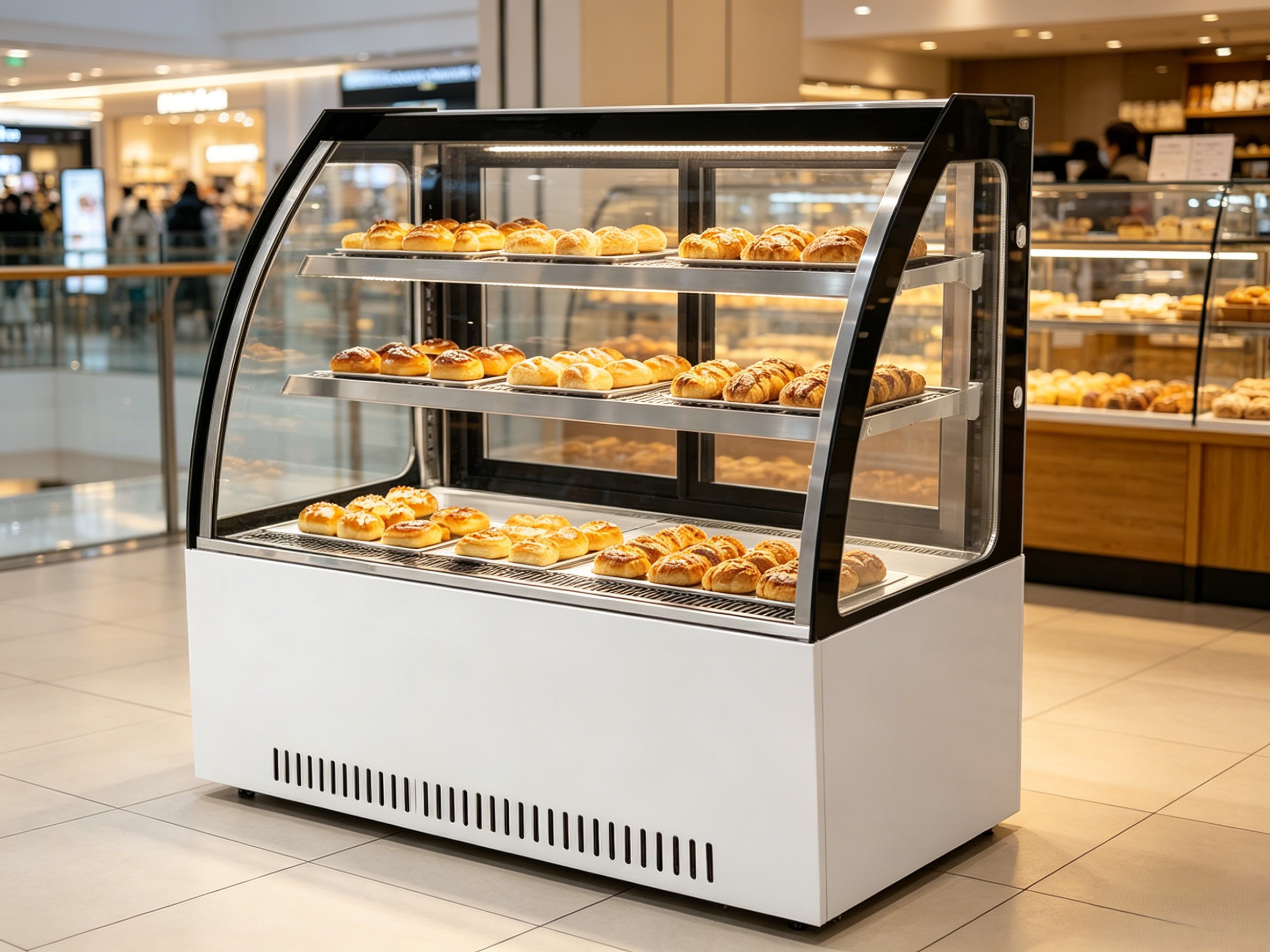
According to professional analysis, non-cooling faults fall into two major categories: pseudo-faults and genuine hardware faults. Pseudo-faults account for more than half of daily malfunctions. They are mostly caused by improper operation, environmental factors or minor peripheral equipment issues, which can be fixed quickly without professional maintenance, making them the top priority during troubleshooting.
Pseudo-Faults Caused by Power Supply and Temperature Control Settings
Pastry display cabinets rely on a stable 220V voltage for continuous operation. During daily business, loose sockets, damaged power cords, tripped circuit breakers, unstable voltage and other problems will prevent the equipment from starting its cooling function normally.
In addition, many store staff may accidentally touch the temperature control panel while cleaning or rearranging the equipment, turning the temperature to an excessively high setting, or mistakenly activating standby or energy-saving modes. The equipment may seem to run normally, but the cooling system remains inactive.
Meanwhile, some users hold wrong operating habits: they still select low-temperature gears under sweltering summer conditions, or fill the cabinet with pastries that block air outlets, hindering cold air circulation and creating an illusion of slow cooling or complete cooling failure.
Moreover, aging and deformed door seals that fail to close tightly lead to continuous leakage of cold air inside the cabinet and influx of hot external air. Over time, the internal temperature cannot drop, resulting in cooling failure. Such issues are often misjudged as malfunctions of core components.
Note that poor heat dissipation and ventilation are also critical triggers of pseudo cooling faults. Most countertop display cabinets adopt rear and bottom heat dissipation structures, so ventilation space must be reserved around the equipment during placement. To save floor space, many stores place the cabinets flush against walls or counters. Alternatively, grease, dust and lint accumulated on condensers and cooling fans are never cleaned, clogging the heat dissipation system. The heat generated by the operating compressor cannot be dissipated in a timely manner, activating the equipment’s overheat protection mechanism, which automatically cuts down cooling power output.
Genuine Hardware Faults of the Core Cooling System
If the equipment still fails to cool normally after ruling out all pseudo-faults, the problem can be confirmed as a genuine hardware fault of the core cooling system. Such faults require targeted maintenance and represent the key focus of equipment repair work, mainly covering four types: air duct fan faults, compressor faults, refrigerant leakage and pipeline blockage, and defrost system faults.
Air duct fan faults directly cut off cold air circulation. If the fan motor burns out, the wiring has poor contact, or fan blades get stuck, the fan will stop rotating. Cold air can no longer circulate, and the compressor will operate abnormally, leading to total cooling failure.
At the same time, a malfunctioning door control switch that cannot reset will keep the fan shut down permanently, completely eliminating the cooling circulation capacity.
The compressor serves as the “heart” of the cooling system. Once it breaks down, the entire cooling system will be fully paralyzed. Common compressor faults are divided into startup faults and running faults.
Startup faults manifest as a buzzing noise after powering on, with the compressor unable to start and automatically shutting down for protection after several seconds. Running faults mostly include compressor cylinder seizing, burnt coils and worn bearings, showing symptoms such as zero compressor response, abnormal operating noise and frequent startup-shutdown cycles.
Main root causes of such faults: long-term overloaded operation of the compressor, inadequate heat dissipation and unstable voltage. These faults are relatively difficult to repair; in most cases, professional technicians are required to replace accessories or conduct full-machine inspections.
Naturally, refrigerant leakage and pipeline blockage can also result in non-cooling issues. Refrigerant acts as the circulation medium for cooling. After long-term service of a pastry display cabinet, aging leakage easily occurs at pipeline welding seams and connectors, causing slow refrigerant loss. In the early stage, cooling performance weakens and temperature drops much slower; in the later stage, the cabinet stops cooling completely once all refrigerant leaks out.
Meanwhile, ice blockages and dirt blockages frequently form inside pipelines. Residual moisture and impurities within the system clog capillary tubes, cutting off refrigerant circulation and paralyzing the entire cooling system.
Typical symptoms of these faults: partial and uneven frost formation. The equipment may appear to run normally yet produce no cooling effect. Professional tools are needed for leak detection, welding repair and refrigerant refilling.
If the fault persists after all the above checks, you may inspect the defrost system. During equipment operation, frost continuously builds up on the evaporator. Under normal circumstances, the defrost system automatically defrosts at fixed intervals. If defrost heaters, defrost sensors or defrost timers are damaged, frost layers will keep accumulating, eventually wrapping around the evaporator and blocking air ducts, which stops cold air from spreading and keeps the cabinet temperature excessively high.
Solutions to Various Types of Faults
Stores may carry out troubleshooting and maintenance step by step following the principle of “simple issues first, complex ones later; external parts first, internal components later” to cut maintenance costs and boost troubleshooting efficiency.
If you are a professional technician, follow these inspection steps:
Step 1: Inspect basic peripheral equipment. Check power voltage, plug wiring and tripped circuit breakers. Reset the temperature control panel and adjust the temperature to the optimal 2–8°C for pastry storage. Clear food items blocking air outlets inside the cabinet, check the tightness of door seals, and replace deformed or aged seals promptly.
Step 2: Clean the heat dissipation system. Cut off power before removing dust and grease from condensers and cooling fans. Leave a ventilation gap of over 10 centimeters between the equipment and the wall to guarantee smooth heat dissipation.
Step 3: Test the air duct and defrost system. Manually press the door control switch to observe whether the fan runs smoothly. Clear thick frost from the evaporator and check if all defrost components function properly.
Step 4: Inspect the core cooling system. If no abnormalities are found in the above checks, the fault is most likely a broken compressor, refrigerant leakage or pipeline blockage. Contact professional maintenance staff for repairs and never disassemble high-pressure pipelines or the compressor by yourself.
If you are not a professional, consult local suppliers directly once a fault emerges instead of disassembling and repairing the cabinet privately, otherwise you may lose your warranty coverage.
In summary, non-cooling faults of countertop pastry display cabinets are either hardware failures caused by long idle time or hardware damage resulting from overloaded operation. Regular daily maintenance is therefore crucial.
Post time: Jun-01-2026 Views: